The Game of Hope
The dice race from around 1799 hidden inside a fortune-telling deck. Answer riddles to steer the dice, then name six hidden voices. No fortunes told.
About the game
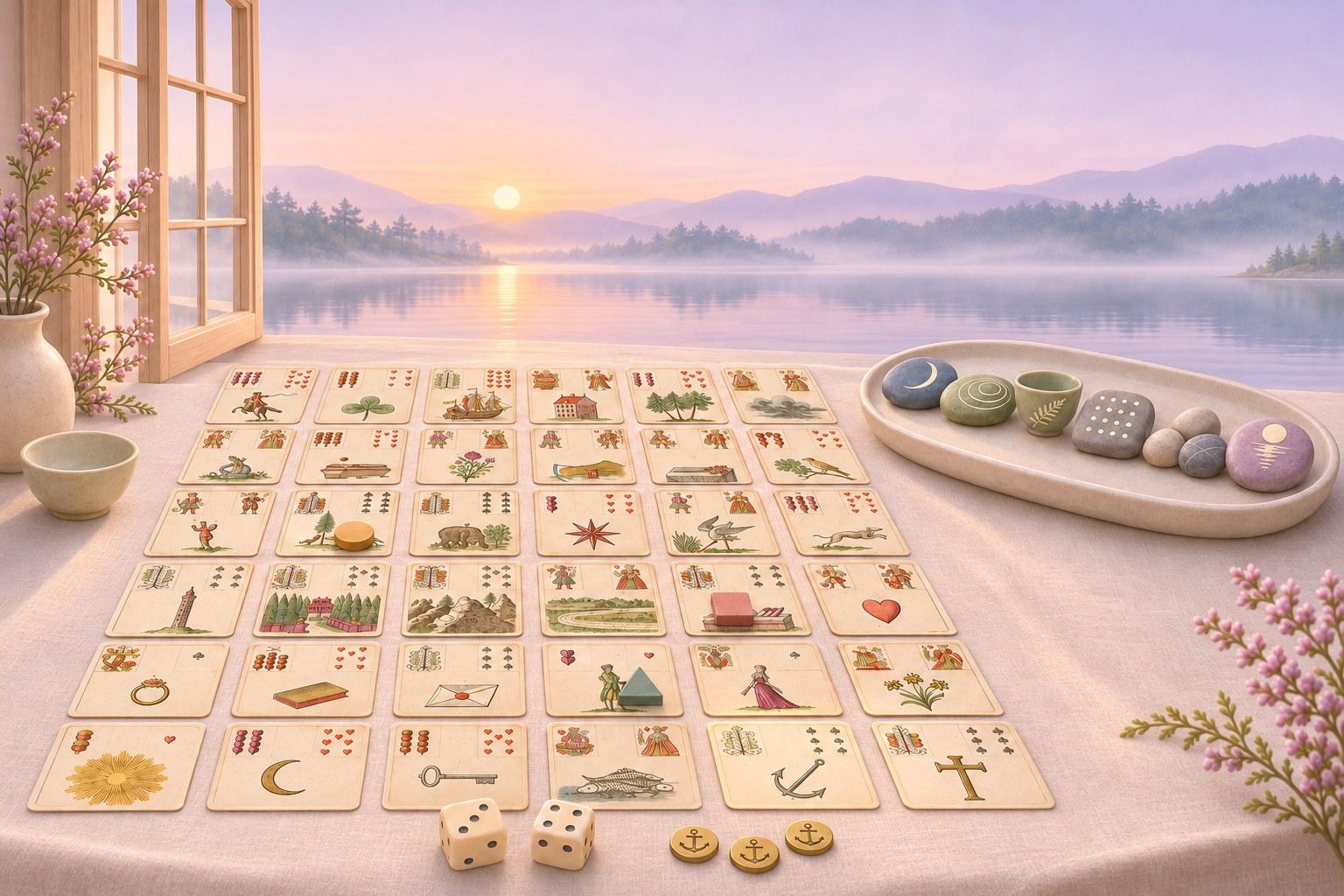
Around 1799, a dice race with 36 picture cards was published in Nuremberg. Less than fifty years later the same cards were sold as a fortune-telling deck under a famous name that had nothing to do with them. The Game of Hope puts the race back on the table, and nothing in it tells your fortune.
There is no map to walk. You sit in a quiet room at dawn, by a window over a misty lake. The Table holds the 1799 race; the Shelf holds 23 volumes, a timeline and your own record; the Window is the Reading Room. There is no avatar and no account. The only cast is six stones, the Astrologer, the Body Reader, the Herbalist, the Strategist, the Skeptic and the Mystic: ways of reading, not characters. They never speak and never race.
At the Table, up to six players share one phone. Before each roll you pick a riddle suit, Older or Younger, Record or Corrected, or the Ladder, and answer a question drawn from the books' own research: which is older, the tarot or this game? A right answer earns a brass mark, three at most, and every answer shows its source. Roll two fair dice, then spend a mark to re-roll one die or to leave a waiting card. The Ship carries you on to the Birds; the Coffin, the Mountain and the Cross make you wait; and only an exact landing on card 35, the Anchor, wins.
Then, alone, take a card to the Window. Six pale cards show the first sentences of one published reading, with the voices' names hidden. Place each stone where you think it belongs, open any card to read on, and press Check. Right stones settle; wrong ones come back with a line saying what that voice reads. When all six are named, the reading closes up whole, in the books' order and labelled with its evidence. Then comes the one question the books always ask: "Which of the six voices did you resist most — and what might that resistance be protecting?" Tap a stone, add a few words, or skip. Your answer stays on your device.
The first release has the full 36-card board, riddle decks built from all 23 volumes (112 dated items, 47 corrected misattributions and 23 ladder cards) and a first set of 49 reading puzzles from three volumes. Play solo against a counter that follows the 1799 rules to the letter, or with up to six people passing one phone, each seat choosing Plain or Deep riddles. Knowledge steers the dice but never decides everything: a perfect scholar still loses about one game in five.
Nothing decays, expires or resets. Every riddle adds its dated item to your timeline, which runs from c. 1275 BCE to today; each volume earns a ribbon after three solved readings; and your private record grows only when you choose. There are no streaks, badges, timers, notifications or daily puzzles. Coming back after a year is the same as coming back tomorrow.
Based on The Council of Six, a 23-volume reference series in which six standing voices read every entry on symbolic and self-knowledge systems, from dream symbols to the I Ching. The game keeps the series' three rules: every reading keeps all six voices, nothing predicts, and evidence is labelled. The dice are fair and logged. They decide how far you move, and they never read you.
The Game of Hope is a complete game design for the mobile web. Development has not started.
Gallery
Concept art: the reading room, with the Table, the Shelf and the Window
Concept art: the six stones, one for each voice, with the counters, dice and marks
Concept art: twelve of the 36 cards redrawn after the 1799 deck, and the three riddle suits
Concept art: the Shelf, with the evidence ladder, the timeline and your private record
Concept art: the Table, the 1799 track read from above with its jumps, waits, riddles and marks
Design mock-up: three phone screens, the Reading Room, the Table and the closing question
Design mock-up: a possible later PC version, an editor's desk built from the same stones and cards