The Vigil Laws: Holding Charge
Hold the unit. Ask it exactly. Put your name to what happened.
About the game
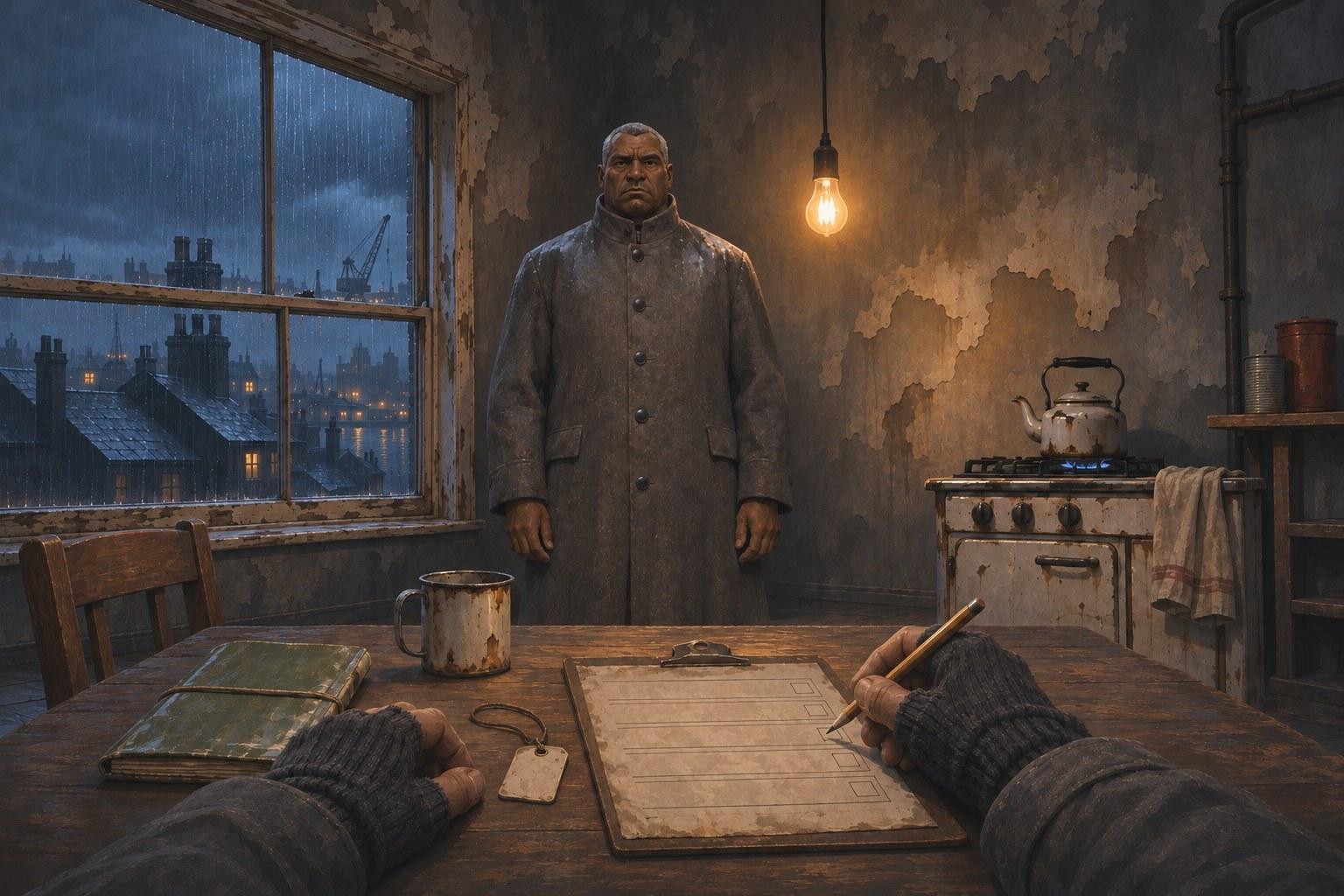
It is the second evening of a holding. The unit you signed for this morning stands by your stove with its hands at its sides. It has not sat down and it will not sleep. Rain runs down the sash, the finding on your table still has three empty boxes, and your notebook holds forty words collected since dawn. One of them makes the question that changes the case.
Kettleburn is a wet, worn port on a drowned coast, forty years after the Sway. Its Vigils are caretakers who cannot be told from a person at three feet: gray Board-issue coats, hands at their sides, bound by four Laws. When one seems to have broken a Law, the Reclamation Boards send an assessor. It is Year 50, the autumn before the first book, and you are new to the job, seen only as your own gloved hands. At the Nailery, the Board's offices in an old nail works, Nilüfer Aksoy hands out dockets, Remy Tumaneng fetches records overnight, and the advocate Teodor Sequeira waits upstairs.
A docket names a unit, a complaint and the Law it seems to break. Sign a holding charge at the rollbox counter on Cadge Street, three thumbprints, and from then on the unit's answers are sworn. Spend three slots a day across the city, from Sink Market to the Ordnance Steps. Read figures by texture, temperature and stillness, never by touch. Collect words from records and statements, and order the paper that turns an answer into evidence.
You cannot type a question. You build it from a frame and the word cards you have found: Did you see THE ENVELOPE move? A held unit must answer you truly, and it will tell you nothing you did not ask: yes, no, a number, a time to the minute, someone's exact words, or "I do not hold that." Every case is won by a better question. Then fill in Form A-7, clip your exhibits to it and defend it aloud at nine in the morning, while the advocate asks what each box stands on. A box that falls adjourns the hearing to the next day. After a second adjournment he offers a quick, clean finding that would have the unit struck. It is a real ending, and you can turn it down.
The first release has four major cases (three holdings and one house inquiry) and eight short dockets, across four in-game weeks and about six hours. It is single-player, in fixed painted first-person views, for keyboard, mouse or controller. Nothing happens unasked: sound stays off until you press SOUND, PLEASE, HOLD stops everything, PLAIN WORDS shows any scene as text, and there is no timed input and no score.
Your grade rises with your findings and opens new kinds of question. The Wall in your flat pins every unit you ruled on and where your words sent it, and a unit you returned can be found at its post later. After the credits, the archive replays any case. There are no streaks, dailies or decay.
The game is based on The Vigil Laws, a series of five novels for adult readers. It keeps the city, the Boards, the Vigils' tells and the holding charge, and it quotes the four Laws only word for word. It has its own people and cases; the books' couples and their love stories stay in the books.
The Vigil Laws: Holding Charge is a complete game design for PC. Development has not started.
Gallery
Concept art: the Nailery, the hub
Concept art: map one, the Ordnance Steps and the market lane
Concept art: the line-up, ten gray coats in the rain
Concept art: units and coats, the three tells
Concept art: the cast sheet
Design mock-up: asking a held unit on the PC screen