Baba Yaga
One night in a house that is alive. Sort the impossible, and let a doll no bigger than your thumb finish what hands cannot.
About the game
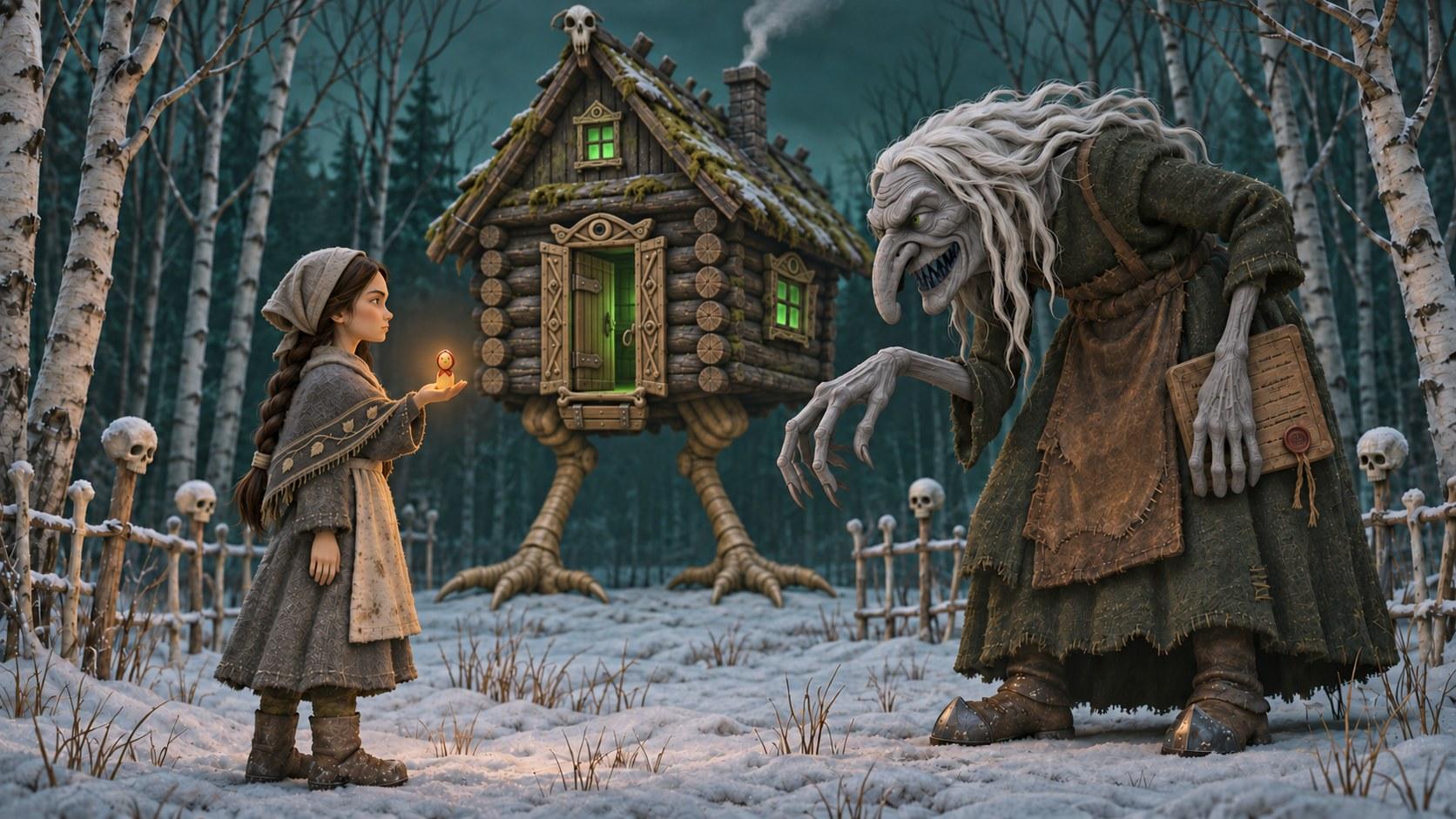
Every fire at home has gone out, and the only flame left burns in the witch's hut. It lowers itself on two scaled chicken legs, the door swings open on green light, and an enormous grey crone with iron teeth sets her terms: lay out my table, route six batches without losing a seed, and ask your little blessing to find what your eyes cannot.
You are Vasilisa, thirteen, in a grey wool dress and your mother's grey shawl edged with birch leaves. In your palm rides Kukla, a carved linden doll with dot eyes and a painted red kerchief: your mother's blessing, fed on a saved crumb of bread and a cup of water. Baba Yaga stands twice the height of anyone in the room, with a sickle nose, small green eyes and wild white hair. She does not chase you; she examines you. Around you the hut breathes slowly: a green hearth, a pantry of sacks and jars, a work alcove and a sorting room, in a snowy clearing ringed by birches and a fence of bone.
The night runs in three movements. Prepare: gather the mixed sack, the empty bushel, the sieve frame, the water cup and the bread crumb, set up the bench and feed the doll until her candle lights. Route: read each batch card's embossed stencil, pick the coarse, fibre or fine sieve, set the Y-shaped gate to straight or cross, test the path safely, then pour. Verify: when the machine has done all it can, ask the doll which pocket still holds a mixture, watch her sort it, and seal all three lots for Yaga's inspection.
The house is not furniture. Twice in the night it warns you, the timber shifts, the green hearth hums, and when it settles the gate may not point where you left it. Then comes the moment the whole trial is built around: fine earth still clings to the seeds, and you set down the tiny doll. Warm light catches her red kerchief, her precise wooden gestures draw the last grains apart, the house goes quiet, and Yaga gives a grudging nod.
The first release is one complete night: one living hut with four connected rooms off its entrance clearing, one seed-and-earth trial in three stages, six batches, three sieves and three sealed lots, for one or two players. Every duty can be done alone. A friend joins as the Guest, with the same hands and permissions: one of you works the bench while the other reads the next card and pings it, and you can swap after every pair of batches. Standard mode gives you twelve minutes of active work before dawn; Guided mode takes the clock away for practice and accessibility. There is no chase and no combat.
There is no currency, no unlock and no grind. If dawn comes first, nothing is lost: keep practising without the clock, or retry the night with your table still set. Finish, and Yaga's acknowledgement brings breakfast and a place to rest; then practise the trial again, together or alone. The rest of the story, and the skull fire, wait beyond this first night.
Baba Yaga adapts the first night of Vasilisa the Beautiful, the Greenlight Publishing novel by Min-jun Park. Vasilisa at thirteen, her mother's thumb-sized doll, the witch's living hut and her three-night bargain all carry over; the Guest, the sorting bench and the shared trial are new to the game.
Baba Yaga is announced for Roblox: the design and the world art are complete, and the build is next.
Gallery
Concept art: the hut's pantry, workroom, hearth and rest nook
Concept art: the living hut
Concept art: blocky Roblox character designs
3D prototype render: the living hut
3D prototype render: the sorting bench (character shown in the earlier, non-blocky style)
3D prototype render: the mother's doll
Design mock-up: title screen
Design mock-up: routing a batch at the sorting bench
Design mock-up: asking the doll for help
Design mock-up: completing the first trial
Design mock-up: Baba Yaga's terms